
Georgia Southern receives renewed funding from the Georgia Opioid Crisis Abatement Trust to continue opioid overdose prevention and education
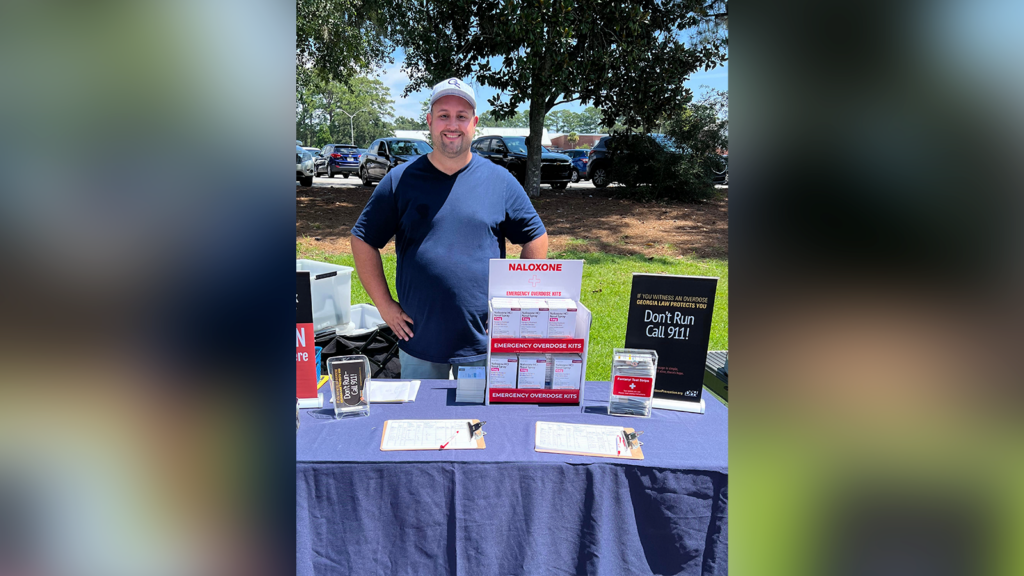
Georgia Southern University recently received a $234,474 grant from the Georgia Opioid Crisis Abatement Trust. The award will expand the University’s naloxone initiative— first launched in 2022, to promote harm reduction and opioid overdose awareness – as well as enhance substance use prevention and education programming.
The new funds will increase on-campus access to naloxone, the opioid overdose reversal drug. During the two-year project period, 2,000 doses of the drug and 5,000 fentanyl test strips will be distributed across the Statesboro and Armstrong campuses, while training an additional 1,000 faculty, staff and students in overdose recognition and response.
A joint effort between the Jiann-Ping Hsu College of Public Health’s (JPHCOPH) Center for Addiction Recovery (CAR), University Health Services, and the Office of Student Wellness and Health Promotion (SWHP), the expansion was inspired by recent data from state and federal agencies.
According to the Georgia Department of Public Health, opioid overdose deaths had nearly tripled for young adults aged 18-24 from 2019 to 2022. Moreover, data from the Centers for Disease Control and Prevention showed that a bystander was present for more than half of the overdoses statewide and a majority chose not to intervene.
Sarah Fischer is doing her part to change that narrative on Georgia Southern’s Campuses. A recent graduate of the University of Massachusetts-Amherst with her Master’s in Community Health Education, she was hired by the SWHP as the Alcohol and Other Drug Prevention Coordinator.
Fischer has only been on campus a short time, developing trainings and promotional materials to further the initiative’s goals.
“Throughout my first month working at Georgia Southern, I’ve already seen firsthand the significant impact this grant is having on our student body,” Fischer said. “Students are engaging in conversations about harm reduction, supporting their community by carrying naloxone, and expressing gratitude that Georgia Southern is providing this resource.”
Director of SWHP, Urkovia Andrews, DrPH, endorsed this perspective, adding that support from the University’s administration reflects Georgia Southern’s commitment to teaching life-long skills.
The team is led by Robert Bohler, Ph.D. Bohler is an assistant professor in the JPHCOPH and serves as the Executive Director for CAR. Sean Bear, DrPH, is taking the lead on the project for University Health Services. As their assistant director and public health administrator, he emphasized the high stakes attached to this work.
“Our mission is to prepare the Georgia Southern community to understand the realities of opioid use, recognize an emergency and feel empowered to step in and respond,” said Bear. “When people have the knowledge and tools to act, they can make a life-saving difference.”
Bohler shared a similar perspective. “This project is designed to prevent addiction and save lives,” he said.